

Travel Cart Design for Hands-Free Adventure

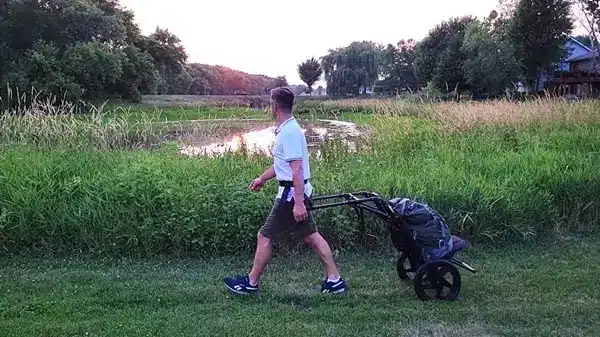
A travel cart should do more than move bags across a smooth terminal floor. It should let you cover uneven trails, crowded streets, campsites, and long approaches without putting every pound on your back. That is the point of a hands-free, human-towed system: your gear rides on its own wheels while you keep moving naturally.
HipStar was built for people who refuse to choose between bringing what they need and feeling good enough to enjoy the trip. It is not a wagon, and it is not a conventional cart you must hold, steer, and constantly balance. It is a body-connected travel cart designed to follow your natural gait while your hands stay free.
Key Takeaways
- A hands-free travel cart moves gear weight onto wheels instead of concentrating it on your shoulders and back.
- A padded waist harness and flexible connections allow the cart to move with your body, not fight against it.
- Two wheels, all-terrain capability, and a low center of gravity make a bigger difference than a cart that merely rolls on pavement.
- One modular frame can support travel, trekking, family outings, long-item carrying, and compact transport.
Why Most Travel Carts Create a New Problem
Traditional rolling luggage works well when the ground is flat and one hand is free. The moment the route includes a curb, gravel path, soft ground, stairs, a crowded platform, or a steep downhill, that convenience can disappear. You are pulling from one arm, twisting your torso to look behind you, and managing a load that wants to tip or drag sideways.
Conventional carts also demand attention. One hand stays on the handle. Your other hand handles a map, a child, a trekking pole, a camera, or a rail. On a long day, that constant pulling and balancing becomes its own kind of fatigue.
Backpacks solve the hand problem but transfer the full burden to your body. Even a well-fitted pack can strain the shoulders and back over distance, especially when food, water, shelter, clothing, and activity gear begin adding up. For active seniors, people managing back discomfort, and anyone trying to preserve energy for the experience itself, carrying everything is not always the answer.
A better travel cart changes where the weight goes. Rather than asking your body to support the load, it lets the wheels do that work.
The Difference Is Weight-Neutral Movement
HipStar connects to a padded waist harness through short straps attached to its handlebars. The cart follows behind the user on two wheels, with the gear load riding on the frame rather than hanging from the shoulders. The result is a weight-neutral feeling that helps reduce the strain of carrying a loaded backpack.
Most gear asks your body to adapt. HipStar adapts to your body.
That distinction matters when the route is measured in miles, not parking lots. A human-towed travel cart must move in rhythm with the person using it. HipStar’s flexible harness and built-in shock absorbers dampen the stop-and-go inertia created by a natural walking or running gait. They are not there to act as ground-bump suspension. Their job is to keep the load from tugging and surging against the user with every step.
When that motion is controlled, the cart becomes less distracting. You can hike with trekking poles, hold a child’s hand, take photos, carry a drink, or simply walk with a more relaxed posture. The outdoors, without the weight.
A Travel Cart Needs to Handle More Than Airports
The word “travel” can mean a business trip with luggage, but it can also mean a multi-day trek, a beach approach, an expedition base camp, or a family day at a festival. The best setup depends on the terrain, the load, and how you plan to move.
For smooth urban routes, a compact suitcase form may be the practical choice. HipStar can be pulled alongside using its top handle, making it familiar for terminals and streets. When it is time to cover rougher ground, the same frame converts to a hands-free trekking cart that keeps the load behind you and your hands available.
That adaptability is useful because trips rarely stay in one environment. A traveler may need a suitcase in an airport, a backpack for a short carry, and a trekking cart at the destination. Families may need a way to carry picnic supplies and then configure the system for a child seat using foam cushions or a car seat. Paddlers and campers may need to carry longer items such as a kayak or canopy.
Seven Modes, One Frame means the equipment can change with the trip rather than requiring a separate piece of gear for every job. HipStar also converts into a bicycle trailer and folds flat for car trunks or airport check-in. The value is not novelty. It is fewer compromises between home, transit, trailhead, and destination.
Control Matters on Real Terrain
All-terrain movement is not just about having wheels. It is about maintaining control when the route changes grade, surface, and pace.
The MD model is designed for hands-free movement without brakes. For heavier loads and more demanding terrain, the HD model adds disc brakes controlled by levers on the grips. That gives the user another level of control on steep downhills, where the cart can be positioned ahead and followed with the brakes applied to keep the load managed.
This is an important trade-off to consider before choosing a system. Not every trip needs braking hardware. A relatively light load on rolling ground calls for something different than a long, gear-heavy route with sustained descents. Choosing for the terrain is practical, not cautious.
The key is that control stays with the person. You are not wrestling a load with one hand while trying to keep your balance. You are walking, adjusting your pace, and using the cart as an extension of your movement.
Who Benefits From Hands-Free Hauling?
The obvious answer is hikers and campers, but the use cases reach much further. Eco-tourists can move personal gear through places where vehicles do not belong. Expedition travelers can carry supplies from transit to trail. Families can bring more of what makes a full-day outing comfortable without turning one adult into the designated pack mule.
Active seniors often see the value immediately. Independence is not only about where you can go. It is about whether you can bring water, layers, food, and essentials without paying for it later in shoulder and back fatigue. A travel cart does not replace good judgment about loads or terrain, but it can make a meaningful difference in how manageable an outing feels.
The same principle matters for first responders, search-and-rescue teams, and military users moving equipment over ground that defeats ordinary rolling luggage. Hands-free mobility leaves more attention for the route, the team, and the task.
More than 750 HipStars are already in use across 32 countries, and both production runs have sold through. That kind of traction comes from a straightforward need: people want to move more gear without giving up their body to do it.
Choose Movement Over Carrying
A travel cart is worth considering when your gear is limiting the distance, comfort, or freedom of the trip. If your route is entirely polished floors and elevator banks, a standard suitcase may be enough. But if travel includes trails, gravel, long walks, changing surfaces, family logistics, or equipment that exceeds what your shoulders should carry, a body-connected cart offers a different way forward.
Carry everything. Strain nothing. Enjoy the outdoors again.
If you are ready to stop carrying and start moving, join the HipStar priority list for 2026 updates, early launch information, and a closer look at the system built to help you pursue your own personal legend.