

Gear Hauling Innovations That Keep You Moving

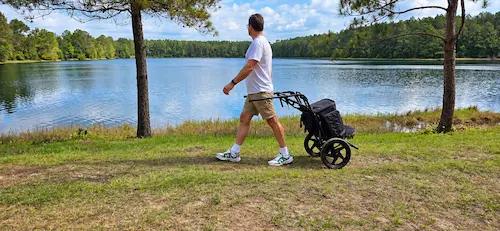
A heavy pack changes the whole trip. Your shoulders tighten, your hands fill up, and every uneven stretch becomes a balancing act. The most meaningful gear-hauling innovations don’t just add storage; they rethink where the weight goes and how you move with it.
Key Takeaways
- Better hauling starts by moving load weight off the back and onto wheels.
- Hands-free movement matters when terrain, children, tools, or outdoor tasks demand attention.
- Natural-gait design can make a loaded cart feel more controlled than a rigid pull system.
- One modular frame can serve different missions without requiring separate gear for every trip.
The Real Problem Is Not Just Heavy Gear
Outdoor gear has become more capable, but it’s not any less necessary. A day hike can involve water, layers, food, first-aid supplies, trekking equipment, and photography gear. Camping adds shelter, cookware, sleeping equipment, and firewood. A family outing can mean coolers, strollers, bags, and the items children decide they cannot leave behind.
The traditional answer is to carry the load yourself. That works until distance, terrain, heat, age, injury history, or fatigue turn carrying into the main event. Backpacks concentrate weight on the back and shoulders. Conventional carts demand constant attention to balance, take up a hand, and get awkward when the route stops being smooth.
The next generation of hauling is focused on a simpler principle: let the wheels carry the load while the person keeps moving naturally. That is a practical shift, not a gimmick. It gives people more room to hike, travel, work, respond, and explore on their own terms.
Gear Hauling Innovations Begin With Weight Transfer
The strongest hauling designs don’t ask the user to get stronger to manage the gear. They transfer the gear’s weight to the frame and wheels. The difference is easy to see when a load is positioned correctly: instead of lifting and supporting it with your shoulders, you pull it forward.
That is the thinking behind HipStar, a body-connected, human-towed travel cart built around a padded waist harness and two all-terrain wheels. Short straps connect the cart’s handlebars to the harness, leaving both hands free while the load rides on its own frame behind the user.
The patented weight-neutral system is designed so the handle-to-frame angle adjusts to the load. This keeps the center of gravity above and slightly ahead of the axle, letting the frame carry nearly all the weight. The user is not carrying the load – they are moving it.
That distinction matters on a long trail, through an airport, across a field, or during a job where hands need to remain ready. Carry everything. Strain nothing. Enjoy the outdoors again.
Why hands-free is more than a convenience
Hands-free hauling changes what users can do while moving. Hikers can use trekking poles, handle a map, take a photo, or steady themselves on uneven ground. Parents can stay closer to a child. Search-and-rescue teams and first responders can keep critical tools within reach. Active seniors can focus on their footing instead of wrestling a load and a handle at the same time.
It also changes confidence. When gear isn’t pressing into your shoulders or forcing one arm to manage a cart, a route can feel more approachable. The goal is not to remove the challenge from the outdoors. It is to remove unnecessary strain that keeps people from getting there.
Natural Gait Is an Engineering Requirement
People do not move in a perfectly smooth line. Walking has a stop-and-go rhythm, and running magnifies it. A hauling system that ignores that rhythm can tug, surge, or bounce against the user with every step.
HipStar uses shock absorbers and a flexible harness to dampen the stop-and-go inertia created by natural gait. This is not about masking rough ground. It reduces the repeated pull-and-release motion between person and load, helping the cart stay steadier as the pace changes.
That detail is especially useful when hauling gear across varied terrain. A system should move with you rather than forcing you to adapt your stride around it. Most gear asks your body to adapt. HipStar adapts to your body.
For heavier loads and descents, the HD model adds disc brakes with levers on the grips. The MD model doesn’t include brakes, which may suit users whose routes and loads don’t call for that added control. The right configuration depends on where you travel, what you carry, and how much control you want on changing grades.
One Frame Should Earn Its Place
Innovation is not always about adding another specialized product to the garage. For people who hike, camp, travel, and support a family, versatility can be just as valuable as performance.
HipStar is built around Seven Modes, One Frame. In Cart mode, it moves gear hands-free behind the user. Backpack mode gives the frame a different carrying role, while Suitcase mode uses the top handle for pulled travel. Bicycle mode attaches to the seat post, and Kayak mode supports long items like kayaks or folded canopies.
The same platform can also be used in Child-Seat mode with a car seat or foam cushions, then fold flat in Travel mode for storage, transportation, or airport check-in. The point is not to claim that every person needs every mode. It is to make one piece of equipment useful across the changing demands of real life.
A weekend camper may rely on Cart mode and Travel mode. A family may see value in a different combination than a solo hiker. A field professional may prioritize hands-free movement and control. Good design leaves room for those differences.
Hauling Innovation Supports Independence
Gear hauling has a physical side, but also an emotional one. People often stop taking certain trips not because they have lost interest, but because the logistics have become punishing. A pack that once felt manageable can start causing fatigue or back pain. A pile of family gear can turn a simple outing into a major operation.
Moving the load off the body helps preserve independence. It can mean taking the longer path, bringing the equipment that makes a trip comfortable, or saying yes to an outdoor day without calculating how badly your shoulders will feel afterward.
That is why the design has connected with hikers, campers, travelers, families, active seniors, military users, and response teams. More than 750 HipStars are in use across 32 countries, and both production runs sold through. That traction comes from a problem people immediately recognize: gear should support the mission, not limit it.
The Future of Hauling Is Human-Centered
The best gear hauling innovations will keep moving away from the old assumption that effort equals endurance. Endurance is not about accepting avoidable discomfort. It is about having the energy, control, and confidence to keep going.
For some people, that means replacing a punishing backpack on long routes. For others, it means moving camping gear from the car to the site without exhausting themselves before they set up the tent. For a traveler, it can mean getting through terminals with both hands available. The use cases differ, but the need is the same: practical mobility without sacrificing freedom.
Making the outdoors enjoyable again – for every body – starts with designing around how people actually move. When gear weight rides on wheels, hands stay free, and the system follows the user’s natural gait, more distance becomes possible.
If you are ready to stop carrying and start moving, join the HipStar priority list for 2026 updates and early access information.
Let your next trip be defined by where you want to go, not by what your shoulders can handle.