

What a Hiking Trailer Should Do for Your Body

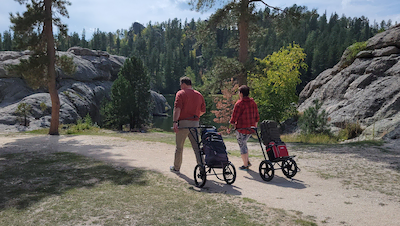
A hiking trailer should solve the problem that starts before the first mile: too much gear on your back. Water, shelter, food, layers, recovery supplies, and the small things that make a long day workable all add up. When that load sits on your shoulders, every climb, uneven step, and strap adjustment takes a little more out of you.
The better question is not how much weight you can tolerate carrying. It is how much freedom your gear leaves you to move. A human-towed, hands-free cart changes that equation by moving the load onto its own wheels while keeping your hands free for trekking poles, a map, a child’s hand, or simple balance.
Key Takeaways
- A hiking trailer built for people should be body-connected and human-towed, not treated like a vehicle trailer or a wagon.
- Weight-neutral design matters because it transfers gear weight to the frame and wheels instead of your back and shoulders.
- Hands-free movement is especially valuable on uneven ground, during long approaches, and when you need to use poles or carry other essentials.
- The right system should work beyond the trail, from hauling at the campground to travel and everyday errands.
Why a hiking trailer needs to work with your gait
Ordinary carts work on smooth pavement, but trails and variable terrain quickly expose their limits. A rigid handle can pull at an awkward angle. A load that sits behind the axle can feel like it is dragging you backward. And a cart that demands both hands takes away the tools many hikers rely on to stay steady.
A purpose-built hiking trailer needs to move with your natural gait. That means a padded waist harness connected to the cart by short straps, with handlebars that follow behind the body rather than requiring a constant grip. The user provides the pulling force, but the frame carries nearly all the load.
That distinction matters. Pulling is not the same as carrying. When the load is balanced over and slightly ahead of the axle, the cart can feel remarkably weightless at the harness. You are still moving the gear, but you are no longer supporting it with your spine, shoulders, and hips mile after mile.
HipStar approaches this as an engineering and mobility problem, not a packing challenge. Its patented weight-neutral system uses an adjustable handle-to-frame angle to keep the center of gravity where it needs to be as the load changes. The result is a human-towed cart that lets the wheels do the heavy work while the person remains in a natural, upright position.
Hands-free is more than a convenience
Hands-free movement is often described as a comfort feature. On a real trail, it is a control feature too. Free hands let you plant trekking poles on a steep section, reach for a railing, check navigation, open a gate, or steady yourself when the terrain shifts underfoot.
It also makes the experience more social and more capable. A parent can keep a hand free to hold a child. A photographer can respond when the light changes. A camper can carry firewood, water, or a folded chair without turning each trip from the car to the site into a balancing act.
This is where conventional backpacks ask for compromise. Pack light, carry less water, leave the camp comfort behind, or accept soreness as part of the outing. Some days, a small backpack is exactly right. But for multi-day camps, family outings, long walks, field operations, or anyone managing back and shoulder fatigue, the load becomes the limiting factor.
A hiking trailer gives you another option: bring what the day actually requires without turning your body into the cargo platform.
The details that keep a load composed
Terrain isn’t just about rocks, roots, and grades. It is also about the repeated stop-and-go rhythm of walking. Every stride creates small speed changes. Without a system to manage that motion, a loaded cart can surge, tug, and interrupt your rhythm.
HipStar uses shock absorbers and a flexible harness to dampen that gait-driven inertia. They are not there to act as suspension for ground bumps. Their job is to smooth the stop-and-go movement created by the person walking, helping the load stay steadier behind you, even when you pick up the pace.
On descents and with heavier loads, control matters as much as balance. The HD model includes disc brakes with levers on the grips, giving the user braking control when gravity starts working against the route. The MD model has no brakes, which may suit lighter-duty use where that extra downhill control isn’t needed.
The right choice depends on where you go and what you carry. A relaxed campground route and a steep, gear-heavy approach demand different things of your equipment. Good design does not pretend otherwise.
One frame, more ways to keep moving
Outdoor gear often becomes a storage problem the moment you leave the trail. A specialized item may perform well in one setting, then sit unused for most of the year. That is why versatility is part of practical mobility.
HipStar is built around Seven Modes, One Frame. The same modular frame can work as a hands-free Cart, Backpack, Suitcase, Bicycle attachment, Kayak carrier for long items, Child-Seat setup using a car seat or foam cushions, and a flat-folding Travel mode. Each mode addresses a different way people move gear through real life.
That flexibility matters for active adults who refuse to shrink their range. Use it to haul camp supplies, move luggage through an airport, bring equipment to an event, or carry long, awkward items that do not belong on your back. The frame doesn’t ask you to become a different kind of traveler. It is adapting to the way you already move.
More than 750 HipStars are in use across 32 countries, and both production runs sold through. That traction comes from a straightforward need shared by hikers, campers, travelers, active seniors, search-and-rescue teams, and military users: gear should expand what you can do, not dictate when it is time to stop.
Choose mobility, not another burden
Before choosing a hiking trailer, picture the hardest part of your normal route. Is it the long walk from parking to camp? The climb where your shoulders begin to burn? The descent where you need both hands? The airport transfer after an adventure trip? Those answers should shape the system you choose.
Look for body connection, true hands-free operation, a load position that supports your natural balance, and a frame that meets more than one need. Be skeptical of any design that simply relocates the burden from your back to your arms. If you are still bracing, lifting, and fighting the load, the gear has not really changed the experience.
The outdoors, without the weight, is not about taking more than you need. It is about refusing to let unnecessary strain decide how far you can go.
Join the priority list for early-bird pricing, to follow the next release, and to make room for the adventures your body still wants to pursue.