

Outdoor Load Distribution for Longer Days Outside

Outdoor Load Distribution for Longer Days Outside
A steep trail has a way of exposing bad load design. The problem is not always how much gear you packed. It is where that weight goes when you climb, step over roots, turn to check a map, or stop suddenly on uneven ground. Outdoor load distribution is the practical work of moving weight through your body and equipment in a way that protects your mobility instead of steadily draining it.
A traditional backpack puts nearly every consequence of a heavy load on your shoulders, back, hips, and legs. A conventional cart may take weight off your body, but it can demand a hand, pull to one side, and become difficult when terrain changes. The better question is not simply, “How can I carry more?” It is, “How can I keep moving naturally while bringing what the trip requires?”
What Outdoor Load Distribution Actually Means
Load distribution is often discussed as a backpack-fitting issue: tighten the hip belt, adjust the shoulder straps, and place heavier items close to the spine. Those details matter. But they only redistribute load across the body. They do not remove the central challenge that the body is still carrying the gear.
Outdoor load distribution takes a wider view. It considers the path of force from the gear to the ground, the way the load behaves during a natural walking rhythm, and whether the person can move with both hands free. For a short walk from the car to a campsite, a conventional pack may be perfectly reasonable. For a long approach, a multi-day outing, a family trip, or a field response, the strain compounds one step at a time.
The goal is not to eliminate effort. Hills still require work. Loose ground still demands attention. Instead, good distribution reduces unnecessary effort: the constant pull on the shoulders, the forward lean that develops under a pack, and the small corrections needed to keep a swinging load under control.
Why Weight Location Changes the Whole Day
Two people can carry the same amount of gear and have completely different experiences. One finishes the day tight through the neck and lower back. The other still has the energy to set up camp, cook, explore, or help a child over the last stretch of trail. Load placement is often the difference.
When gear sits high and close to your body, it can be easier to control than a loose, poorly packed load. But body-borne weight still affects posture and gait. The heavier the load, the more the body tends to compensate. That may mean shorter steps, a forward-leaning position, tired shoulders, or frequent stops to adjust straps.
Wheeled systems introduce another option: transfer the gear weight to the wheels while retaining control over the load. The trade-off is clear. Wheels need to match the route. A smooth airport floor, a gravel path, a wooded trail, and a rocky hillside each ask different things of a carrier. Ordinary luggage excels on hard, level surfaces. It is not designed for the terrain that outdoor users regularly encounter.
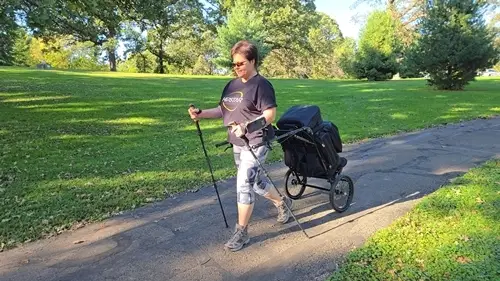
A purpose-built all-terrain system can change that equation by keeping the load on wheels without making you manage a handle every moment. Hands-free movement matters because it leaves you able to use trekking poles, steady yourself, carry a water bottle, open a gate, guide a child, or respond to changing conditions without abandoning your gear.
The Difference Between Pulling a Cart and Moving With One
A cart attached to your body must do more than roll. It must move in rhythm with you.
Walking is not a smooth, continuous motion. Every step includes a start, a stop, and a shift in direction. When a load lags behind that motion, it can tug against the body. When it surges forward, it can interrupt your stride. That stop-and-go inertia becomes more noticeable over distance, especially with uneven pacing, turns, and changes in elevation.
HipStar addresses this through a patented, weight-neutral system that transfers gear weight from the body onto the wheels. Its flexible harness and built-in shock absorbers are designed to dampen the stop-and-go inertia of the human gait, helping the load stay steady as the user walks or runs. The purpose is not to make rough ground disappear. It is to reduce the repetitive push-pull motion between the user and the gear.
That distinction matters. Terrain handling and gait handling are related, but they are not the same problem. A useful outdoor mobility system needs to deal with both: wheels capable of traveling beyond pavement, and a connection to the user that does not turn every stride into a tug-of-war.
Pack Smarter Before You Pack More
Even with a strong load-transfer system, thoughtful packing remains part of the job. The goal is a stable load that does not shift, snag, or force repeated reorganizing on the trail.
Start with the gear you will need first. Water, rain layers, navigation tools, sunscreen, and first-aid supplies should be reachable without dismantling the entire setup. Place dense items where the carrier is designed to hold them securely, then use softer equipment to fill gaps and limit movement. Tent fabric, clothing, and sleeping gear can protect awkward items while also keeping the load from rattling around.
Avoid the temptation to bring every possible comfort item simply because wheel support makes more space practical. Better load distribution can make a larger kit easier to move, but it does not remove the need for judgment. Consider trip length, weather, water access, group needs, and the route ahead. Carry what gives the trip purpose and resilience, not clutter.
Before leaving, walk around the block or across a nearby uneven surface. Make a few tight turns. Stop quickly. Step up and down a curb. This small test can reveal a shifting load, an awkward attachment point, or equipment that needs to be packed differently. It is easier to solve those problems at home than halfway through a trail day.
One System, Different Ways to Move
Outdoor travel rarely stays in one mode. A family may load gear at home, travel through an airport, roll across a campground, and take a day hike from the same base. A paddler may need to move a long item to the water before switching to trail gear. A responder may need hands-free while transporting essential equipment over changing ground.
That is why modularity is more than a convenience. It reduces the number of separate carriers required for different parts of the journey. HipStar’s approach is Seven Modes, One Frame: a hands-free all-terrain trekking cart, backpack, alongside suitcase, bicycle trailer, kayak or canopy carrier for long items, child-seat setup using foam cushions or a car seat, and a fold-flat travel form for trunks or airport check-in.
No single mode is right for every route. A backpack format can be useful when a path is too narrow or terrain requires a different approach. A bicycle trailer can make sense for the ride to a trailhead. The hands-free trekking configuration is built for the moments when the real goal is simple: keep walking without putting the full burden of the gear back on your body.
Who Benefits Most From Better Load Transfer?
The case for better distribution is not limited to extreme expeditions. Campers hauling food and shelter beyond a parking area feel it. Parents moving supplies with children feel it. Travelers moving through terminals and unfamiliar streets feel it. Active seniors who want to keep covering ground on their own terms feel it too. More than 750 HipStars are now in use across 32 countries, with both production runs sold through — the same load-transfer approach, tested by very different users on very different ground.
For search-and-rescue, first-response, and military users, the need can be even more direct. Hands may be needed for communication, navigation, assistance, or technical tools. Equipment has to remain controlled while the person moves through conditions that do not respect a neat, flat surface. The right configuration always depends on mission requirements and terrain, but reducing unnecessary body strain can preserve attention for the work itself.
There is also a less dramatic benefit: enjoyment. When every mile becomes a negotiation with shoulder pain and fatigue, the destination starts to feel like a task. When gear movement supports a natural gait, more of your energy remains for the reason you went outside in the first place.
Build Your Route Around Movement, Not Limitation
The outdoors asks people to adapt constantly. Weather changes. Trails narrow. Kids get tired. A planned overnight turns into a longer approach than expected. Gear should not be another obstacle demanding all your attention.
Start by looking honestly at your route and your body. Choose the carrier mode that suits the terrain, pack for stability, and test the setup before the trip matters. Then let the system do its share of the work. The outdoors, without the weight, is not about avoiding the challenge. It is about keeping more of yourself available for it. If that is the way you want to move, join the HipStar priority list to be first in line when the next production run opens.