

Walking Trailer: Walk Hands-Free While the Wheels Carry Your Gear

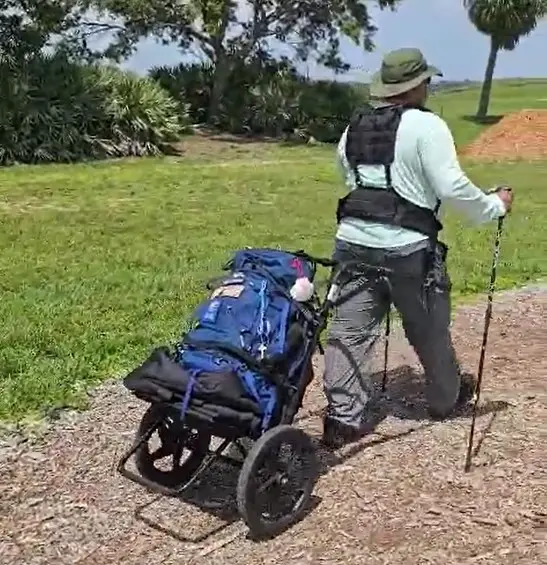
A long walk should be about where you’re going, not about what you’re carrying. Yet a beach day, a walk to the campsite or a full day of sightseeing usually means a heavy bag on your shoulders. Water, food, layers, a blanket, a camera, or a child’s things all add up, and the weight tells you about it before the day is over.
A walking trailer offers a different answer. Instead of carrying the load, you walk, and the trailer brings your gear along behind you on its own two wheels.
What is a walking trailer?
A walking trailer is a small two-wheeled cart that you pull while you walk. Unlike a wagon or a hand cart, a good walking trailer connects to your body rather than to your hands, so your arms stay free.
HipStar® is a patented, weight-neutral, hands-free walking trailer. You wear a padded waist harness, and two handlebars connect to it with short, flexible straps at about hip level. That hip connection is where the name HipStar comes from. The load rides behind you on two large wheels, and you simply walk.
Most gear asks your body to adapt. HipStar adapts to your body.
Why your back and shoulders feel the difference
Carrying weight strains the back and shoulders. On a long walk, it also brings fatigue sooner and can turn an easy outing into hard work. Seniors and people with back problems often feel it even more.
A walking trailer takes that load off your body. With HipStar, the ergonomic hip connection transfers the weight onto the wheels, so you move hands-free with far less strain on your back and shoulders.
You are not carrying the load. You are moving it.
Why HipStar feels weightless
Pulling a cart isn’t automatically easy. If a load sits in the wrong place, it pushes and pulls against you with every step. HipStar is designed to prevent that in two ways.
- Balance. The load rides balanced on top of the two-wheel axle. You adjust the angle between the handlebars and the frame to suit the load, so the center of gravity stays above and slightly ahead of the axle. The frame supports almost all of the weight, and you apply only the pulling force needed to move.
- Smooth movement. Walking is a series of small speed-ups and slow-downs. Built-in shock absorbers and the flexible harness straps even out that stop-and-go motion, so the load stays steady, even at a run.
The result: the load feels weightless. Feel the weight disappear. For a closer look, watch the balancing video on our Video Manual page.
Where a walking trailer makes sense
A walking trailer is useful anywhere you walk with more than a small bag:
- Beach days: bring the cooler, umbrella, towels and toys without making several trips.
- Campgrounds: move water, firewood and camp supplies from the parking lot to your site.
- Long walks and day trips: carry water, food and extra layers for the whole day.
- Travel and sightseeing: keep your hands free for a map, a camera or a railing.
- Families: in Child-Seat Mode, HipStar can carry a child using a car seat or foam cushions.
- Active seniors: keep walking further without a heavy bag on your shoulders.
- First responders and search and rescue teams: move equipment while keeping both hands free.
Making the outdoors enjoyable again, for everybody.
Seven Modes, One Frame
A walking trailer that only works on a walk would spend most of the year in storage. HipStar is built around one modular aluminum frame, lightweight and durable, that adapts to how you travel:
- Cart Mode: the walking trailer itself, hands-free with the waist harness.
- Backpack Mode: worn as a backpack with the optional padded shoulder straps, for steps, obstacles and river crossings.
- Suitcase Mode: pulled alongside by the top handle, like a suitcase.
- Bicycle Mode: attached to a bike’s seatpost with the bike mount.
- Kayak Mode: carries kayaks and other long items.
- Child-Seat Mode: carries a child using a car seat or foam cushions.
- Travel Mode: folds compactly for storage and travel, including airport check-in, and packs into the carrying bags.
Features that matter on a walk
- Large all-terrain, flat-free wheels
- Built-in shock absorbers
- Adjustable, intuitive balance
- Comfortable padded harness
- Retractable kickstand
- Compact folding for storage
Two models: HipStar MD and HipStar HD
- HipStar MD (no brakes): a natural choice for walks on flatter routes such as beaches, parks, campgrounds and city streets.
- HipStar HD (disc brakes): brake levers on the grips give you control with heavier loads and on hilly or challenging terrain.
More than 750 units have shipped to 32 countries, and all production runs have sold through.
Frequently asked questions
Is a walking trailer the same as a hiking trailer? They’re closely related. “Walking trailer” usually refers to everyday walks, beach days, campgrounds and travel, and “hiking trailer” to trails. HipStar is designed for both. If you mostly walk on trails with heavier loads, read What a Hiking Trailer Should Do for Your Body.
Do I need to hold the walking trailer? No. HipStar connects to a padded waist harness, so you walk fully hands-free. No arm or upper-body strength is needed.
Which HipStar model should I choose for walking? The MD (no brakes) suits flatter routes. The HD (disc brakes) adds control for heavier loads and hilly terrain.
Can I travel with HipStar? Yes. In Travel Mode, the frame folds compactly and packs into the carrying bags for storage and transportation, including airport check-in.
How can I get a HipStar? The production runs have sold through. Our next campaign is planned for early 2027. Join the priority list to hear first and get early-bird pricing.
More answers are on our FAQs page.
Stop carrying. Start moving.
The outdoors, without the weight. Join the HipStar priority list to be the first to know when reservations open and get access to early-bird pricing.