

How to Carry Gear Without Shoulder Pressure

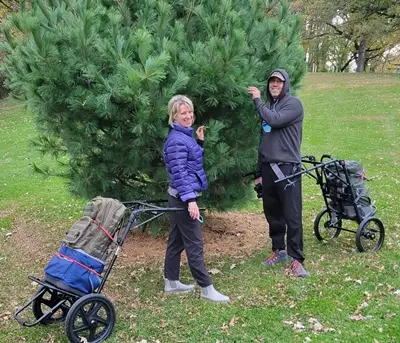
A loaded pack can turn a trailhead, airport terminal, or campsite into a negotiation with your own body. To carry gear without shoulder pressure, the answer is not always a better shoulder strap. It is often a different way to move the load altogether.
Traditional backpacks place the burden directly on your back, shoulders, and hips. Hand carts remove some of that body weight, but demand a hand, pull awkwardly over uneven ground, and can make every curb, root, or slope a balancing act. For people who want to stay self-sufficient over distance, neither option solves the whole problem.
Key Takeaways
- Shoulder pressure starts when your body becomes the platform supporting the load.
- A body-worn, two-wheeled cart can transfer gear weight onto its own wheels while keeping both hands free.
- Natural-gait control matters as much as capacity, especially when walking farther or moving over variable terrain.
- The right setup depends on terrain, load, pace, and whether you need control on descents.
Why shoulder pressure builds so quickly
Your shoulders are designed to move, stabilize, reach, and react. They are not an ideal long-distance shelf for camping equipment, travel bags, water, recovery gear, or family essentials. Even when a pack has padded straps and a hip belt, the load still rides on your body. The pressure may be distributed more intelligently, but it has not disappeared.
That difference becomes obvious after the first mile. Shoulder straps can compress, packs can pull backward, and every step creates small shifts in momentum. The body responds by changing posture, tightening through the upper back, and working harder to stay balanced. On longer routes, fatigue can be less about the destination than the constant effort of holding gear in place.
A rolling solution is not automatically better. Conventional carts and luggage are often designed for smooth, predictable surfaces. When terrain gets uneven, the user must keep one hand occupied, manage the handle angle, and correct the cart whenever it wanders or catches. The gear is off your shoulders, but the problem has simply moved into your arm, wrist, and attention.
Carry gear without shoulder pressure by moving weight to wheels
The most direct way to reduce shoulder loading is to stop asking your shoulders to support the gear. A human-towed cart changes the load path: your body provides direction and forward motion, while the cart’s wheels carry the gear.
HipStar is built around that principle. Its padded waist harness connects to the cart’s handlebars with short straps, creating a hands-free connection between person and load. The cart follows behind on two wheels, so the equipment rides on the frame rather than hanging from shoulder straps or requiring a hand to pull it.
This is not a wagon and not a vehicle-towed trailer. It is a person-powered travel cart designed to move with the user. The patented weight-neutral system transfers gear weight onto the wheels, helping reduce the strain that comes from carrying a load on your back and shoulders.
That design also protects something people often overlook: free hands. Hands-free movement means you can use trekking poles, carry a map, steady yourself on uneven ground, hold a child’s hand, open a gate, or react quickly when footing changes. The value is practical, but it is also personal. Moving with confidence makes it easier to keep choosing the trips and tasks you do not want to give up.
Natural gait matters more than a rigid pull
A load can be on wheels and still feel irritating if it jerks forward and backward with every step. Human movement is not perfectly smooth. We speed up, slow down, stop, turn, and change stride without thinking about it.
HipStar uses built-in shock absorbers and a flexible harness to dampen the stop-and-go inertia created by that natural gait. The goal is not to treat the system as ground-bump suspension. It is to keep the connection between you and the load steadier as you walk, so the cart does not repeatedly tug against your body.
That distinction matters on a long day. A rigid cart connection can make a moderate load feel present with every stride. A system designed around human movement can make the load feel far less intrusive, including when the pace picks up. You are still doing the work of traveling, but you are not constantly bracing against gear.
Match the setup to the route
The best way to move gear depends on where you are going. A traveler crossing an airport and a hiker moving over a rutted forest path face different obstacles, but both benefit from keeping a load stable and manageable.
For hiking, camping, expedition travel, and outdoor events, the hands-free trekking-cart mode keeps equipment rolling behind you while your upper body stays available for movement and balance. For trips that include roads, terminals, and storage transitions, the same modular frame can become a backpack, a suitcase pulled alongside by its top handle, or a fold-flat travel form for trunks and airport check-in.
The system can also shift into a bicycle trailer, a carrier for long items such as a kayak or canopy, or a child-seat configuration using foam cushions or a car seat. Seven Modes, One Frame means the frame can meet the reality of a trip rather than forcing you to own a separate solution for every leg of it.
There are trade-offs. A backpack may still make sense for a very light, quick outing where you need to climb, squeeze through narrow spaces, or keep every item directly on your body. A rolling cart makes more sense when gear volume, distance, shoulder comfort, or hands-free movement becomes the limiting factor. Good load planning is not about declaring one tool right for every scenario. It is about refusing to carry more strain than the route requires.
Control on hills is part of independence
Downhill travel changes the equation. Gravity can push a loaded cart forward, which is why load control matters as much as weight transfer. HipStar’s HD model includes disc brakes with levers on the grips for heavier loads and challenging terrain.
On steep downhills, the cart can be positioned ahead of the user and followed with the brakes applied. This gives the user a controlled way to manage the descent rather than fighting a load from behind. The MD model has no brakes, so route conditions and intended use should guide that choice.
This kind of control is especially relevant for active seniors, families carrying more than usual, search-and-rescue teams, and anyone who has learned that discomfort can shrink a route before the trail does. Better gear movement is not about making every outing effortless. It is about keeping the physical challenge focused on the experience, not on an avoidable burden.
Built for people who still want to go
The outdoors, without the weight, is not a promise that terrain becomes easy. It is a commitment to make gear movement more practical for real bodies and real routes. When the load rolls on its own wheels, your shoulders can do what they are meant to do: help you move, reach, balance, and explore.
HipStar has shipped more than 750 units to 32 countries, with both production batches sold through. That traction reflects a simple need shared by hikers, travelers, parents, responders, and people who refuse to let cumbersome gear decide where they can go.
If shoulder pressure is why you shorten trips, leave essentials behind, or skip the route altogether, consider a system that puts the load where it belongs: on the wheels. Join the priority list to follow the next launch and keep moving on your own terms.