

Travel Ergonomics Guide for Moving Without Strain

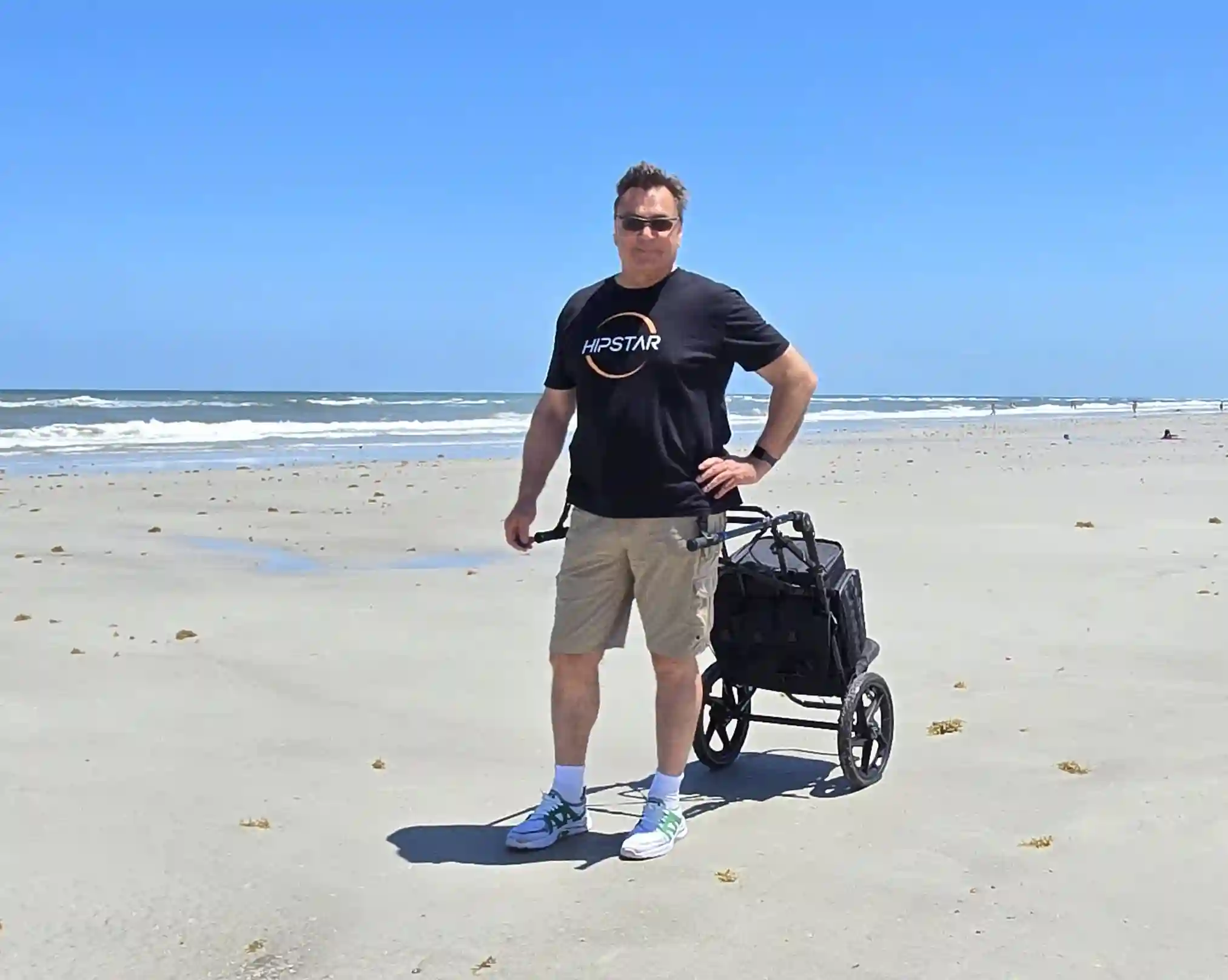
A long airport connection, a steep trail, and a crowded train platform expose the same problem: gear can turn movement into work. This travel ergonomics guide is about keeping your body in charge of the trip, rather than letting a heavy load dictate your pace, posture, and energy.
Key Takeaways
- The closer a load stays to your body’s natural center of movement, the less it fights every step.
- Backpacks are practical for some trips, but carrying all weight on the body can build fatigue over distance.
- Rolling luggage reduces carrying, yet small wheels and fixed handles can demand constant pulling, lifting, and balancing.
- A hands-free, body-connected cart can place gear weight on its own wheels while preserving a natural walking rhythm.
Why Travel Ergonomics Starts Before You Leave
Ergonomics is not just about a padded shoulder strap or a suitcase handle that feels comfortable in a store. It is about how your body performs after an hour on uneven pavement, after a flight delay, or during the last uphill mile to camp.
Every travel setup creates a relationship between your body, your gear, and the ground. When that relationship is wrong, the signs are familiar: shoulders rise toward the ears, one hand stays occupied, your stride shortens, and you start planning around what you can physically manage instead of where you want to go.
The goal is not to eliminate effort. Adventure, travel, and real terrain all require movement. The goal is to remove unnecessary effort – the strain caused by supporting and stabilizing gear that could be carried by a better system.
The Load Problem: Weight Is Only Part of It
A 25-pound load can feel very different depending on where it sits and how it moves. Weight high on the back changes posture. A bag hanging from one shoulder creates an uneven pull. A rolling case may keep weight off your spine, but it can tug behind your arm and force repeated twists when curbs, stairs, gravel, or crowds interrupt the route.
The real ergonomic problem is not simply load weight. It is load behavior. Does it sway? Does it pull you away from your body? Does it require one hand to control it? Does it make you brace against each step?
A well-designed travel system should let you stand upright, move with an even gait, and use your hands for what travel actually demands: opening doors, holding a rail, checking a map, helping a child, carrying a drink, or using trekking poles.
Choose the Right Carry Method for the Route
No single method is perfect for every route. A compact daypack may be the right answer for a short urban walk. A suitcase pulled alongside can work well through a smooth terminal. A full backpack may be useful when your route includes stairs, narrow paths, or situations where you need both hands to climb.
But when gear becomes substantial and distance matters, putting the full load on your back has a cost. The same is true of conventional luggage when the route is not flat, smooth, and predictable. Cobblestones, sand, grass, gravel, curbs, and trail surfaces quickly reveal the limits of gear designed only for polished floors.
That is where a human-towed design changes the equation. Instead of carrying the load or dragging it by one arm, the user connects to the cart at the waist and lets the cart’s wheels support the gear. The best designs keep that connection close to the body, so the load follows your direction without constantly pulling you off balance.
How a Hands-Free System Supports Natural Gait
HipStar approaches travel ergonomics as a load-transfer problem. Its padded waist harness connects to the handlebars with short straps, letting the cart follow behind the user while gear rides on two wheels rather than on the back and shoulders.
The result is a weight-neutral, hands-free approach to moving equipment. You still walk, steer, and choose your line through the terrain, but you don’t carry the full burden of the gear on your body. That difference matters for hikers covering distance, families managing travel days, active seniors protecting their energy, and responders moving essential equipment.
Built-in shock absorbers and a flexible harness are designed to dampen the stop-and-go inertia created by natural gait. They do not act as suspension for ground bumps. Their job is to keep the load from surging against the body every time you accelerate, slow down, or change pace.
This is also why fit matters. A waist connection should sit securely and comfortably, without forcing you to lean forward or over-tighten. Take a few minutes before departure to adjust the harness, organize the load, and walk enough to notice whether anything shifts. A small adjustment at the trailhead or station can prevent hours of irritation later.
Travel Ergonomics Guide: Move Smarter on Real Terrain
Good ergonomics must hold up when the route stops being convenient. On flat paths, stay upright and let your arms swing naturally. Resist the instinct to look down at the load every few seconds. If the cart is balanced and connected properly, it should follow your movement rather than demand your attention.
On climbs, shorten your stride slightly and keep a steady rhythm. Sudden bursts of speed can make any loaded system feel less controlled. On descents, control matters more than pace. HipStar’s HD model includes disc brakes with grip levers for heavier loads and challenging terrain. On steep downhills, you can position the cart ahead and follow it with the brakes applied to keep the load controlled. The MD model has no brakes, so route and load planning matter even more.
Terrain also changes what “efficient” means. A hard-surface city route may favor suitcase mode, pulled alongside by the top handle. A trail day may call for the hands-free trekking configuration. Long equipment, such as a kayak or canopy, needs a different carrying strategy than a duffel. A modular system earns its place when it adapts to the trip instead of asking you to own a separate solution for every scenario.
HipStar’s framework is built around Seven Modes, One Frame: a hands-free all-terrain trekking cart, backpack, suitcase, bicycle trailer, long-item carrier, child-seat configuration using foam cushions or a car seat, and fold-flat travel form for car trunks or airport check-in. The trade-off is that users should learn the configuration that fits their trip before they are standing at the curb with a fully loaded cart.
More than 750 HipStars are already in use across 32 countries, and both production runs are sold through. Join the HipStar priority list to follow the next launch and plan your next route with more freedom.
The outdoors, without the weight.