

Why Luggage Hurts Backs and How to Reduce It

A suitcase can look harmless at the check-in counter, then feel like a full-body problem after one long terminal, a crowded train platform, or a walk from the trailhead to camp. That gap explains why luggage hurts backs: the issue is rarely just the bag’s total weight. It is how often you lift it, how far it sits from your body, and how much it makes you twist, brace, and compensate.
A rolling bag helps in one narrow sense: its wheels support the load. But conventional luggage still asks your arm, shoulder, and spine to manage the handle, the pull angle, curbs, stairs, uneven ground, and every sudden stop. The longer the day gets, the more those small corrections add up.
Key Takeaways
- Back strain often comes from repeated lifting, twisting, and off-center pulling, not one dramatic lift.
- Wheels reduce some load, but a suitcase can still tug your body out of a natural walking position.
- Handle height, packing balance, terrain, and fatigue all affect how luggage feels.
- Moving the load onto purpose-built wheels while keeping your gait more natural can reduce the work your back and shoulders must do.
Why Luggage Hurts Backs: It Changes How You Move
Your back works most comfortably when your load is close to your center of mass and your body can move in a balanced rhythm. Luggage often disrupts both conditions. A backpack places weight directly on your body, while a roller bag places the load behind or beside you and asks you to control it through one arm.
When you pull a suitcase behind you, your arm reaches backward and your torso may rotate slightly to keep the bag tracking straight. Your shoulder stabilizes the handle. Your core resists the uneven pull. On a smooth floor over a short distance, that may feel minor. Over several miles of walking, it can become a constant one-sided demand.
Pulling a bag alongside your body can feel more natural in a tight airport aisle, but it brings its own trade-off. You may lean away from the bag to avoid clipping your heels, shorten your stride, or hold one shoulder higher than the other. None of these movements is necessarily harmful in isolation. The problem is repetition when you are tired, rushed, or carrying more than your body wants to manage.
The Handle Is a Lever, Not Just a Grip
A suitcase handle creates distance between you and the load. The farther that load pulls from your body, the more force your muscles need to control it. This is especially noticeable when the telescoping handle is too short, forcing you to bend or reach, or too long, letting the bag sway behind you.
A poorly matched handle height can turn a simple pull into a posture problem. If you hunch forward, rotate your trunk, or repeatedly jerk the bag back into line, your lower back and upper back are doing extra stabilizing work. A heavy bag does not have to leave the ground to cause fatigue.
Lifting Is Usually the Moment That Gets Blamed
Most people notice their back when lifting luggage into a trunk, onto a luggage rack, or up a flight of stairs. Those lifts matter. Lifting a bag from the floor while you are bent at the waist can put your back in a weak position, especially if you twist before setting the load down.
But the lift is often only the final straw. Your muscles may already be fatigued from pulling, carrying, navigating crowds, and holding awkward positions while checking directions or opening doors. Then the lift feels worse because your body has been working around the load all day.
Packing can make this more difficult. A bag with dense items concentrated far from the handle may tip, drag, or feel unpredictable. A bag that is technically manageable on a scale can still be awkward when its contents shift. Water, tools, camping equipment, camera gear, and family travel essentials tend to create exactly this kind of unstable load.
Stairs, Curbs, and Rough Ground Remove the Advantage of Wheels
Rollers shine on level, hard surfaces. The moment the route includes stairs, gravel, grass, sand, roots, broken pavement, or a high curb, the wheels no longer do all the work. You may have to lift the bag repeatedly, drag it at an angle, or carry it one-handed while trying to keep the other hand free.
This is where ordinary luggage falls short for real travel. An airport traveler may encounter parking lots, shuttle steps, escalators, and narrow boarding areas in the same afternoon. A camper may move from pavement to dirt and then to a rocky path before reaching a site. The bag was designed for one surface, but the trip is not.
Terrain also changes the force you feel through the handle. When a wheel catches, the stop travels up your arm and into your torso. You instinctively brace, pull harder, or change direction. That reaction is useful, but it is another demand on the back, shoulders, and grip.
Fatigue Makes Small Imbalances Bigger
People rarely travel under ideal conditions. You may be jet-lagged, carrying a jacket, watching a child, moving through rain, or rushing to make a connection. In those moments, good lifting technique is harder to maintain and an awkward bag feels heavier than it did at home.
Age, prior discomfort, fitness, and trip length all change the equation. A strong hiker may handle a loaded pack for a day yet still dislike dragging a suitcase through an airport because the movement pattern is so uneven. An active senior may be fully capable of exploring but reasonably unwilling to spend that energy wrestling a load. The goal is not to prove you can tolerate the strain. It is to save your energy for the destination.
Practical Ways to Make Luggage Easier on Your Back
Start before the trip. Pack the heaviest items low and close to the bag’s wheel side or center, depending on the bag’s design, so it is less likely to pull, tip, or swing. Remove what you will not use. A lighter load reduces strain, but a balanced load is also easier to control.
When lifting, get close to the bag, bend through your hips and knees, and avoid turning while the load is in your hands. Lift first, then move your feet to change direction. For an awkward bag, not just a heavy one, ask for help or break the load into smaller pieces when possible.
While rolling, alternate sides if your route allows it. Keep the handle at a height that does not force you to hunch or reach. Slow down at curbs and surface changes instead of yanking the bag over them. These choices will not make a conventional suitcase weight-neutral, but they can reduce unnecessary effort.
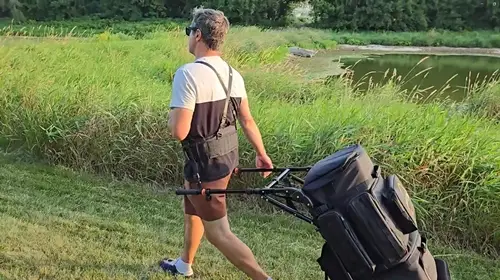
For trips that involve distance, uneven ground, or substantial gear, reconsider the basic carry system. A load solution should support your natural gait rather than force one shoulder and one arm to manage the whole trip. That is the design problem HipStar addresses with a body-worn padded waist harness and a two-wheeled, hands-free cart system: the gear rides on its own wheels while the user remains free to walk, hike, or manage the route.
Its patented weight-neutral design transfers gear weight from the body onto the wheels. Short straps connect the handlebars to the flexible harness, while built-in shock absorbers dampen the stop-and-go inertia created by a human gait. They are not ground-bump suspension. Their job is to help keep the load steadier as you start, stop, and change pace.
The value is practical: fewer awkward handoffs between carrying and pulling, less need to dedicate one arm to a handle, and more freedom to move through terrain that defeats ordinary luggage wheels. The HD model includes disc brakes on the grips for heavier loads and challenging terrain. On a steep downhill, it can be positioned ahead of the user and followed with the brakes applied to keep the load controlled.
More than 750 HipStar units have shipped to 32 countries, and both production batches have sold through. That proof matters because load management is not a cosmetic travel problem. For hikers, families, expedition travelers, active seniors, and field teams, it can determine how far and how comfortably they can go.
The outdoors, without the weight.
Your body should not be the suspension system for every bag, box, and piece of travel gear. Choose a packing method that respects the route, use wheels where they truly help, and avoid treating discomfort as the unavoidable price of getting outside.
If you want to move more gear with less strain on your back and shoulders, join the HipStar priority list for early access and launch updates. The outdoors, without the weight, starts with a better place to ride the load.